
 Enter
Enter






Flight Confirmation
Check your charter flight schedule 24 hours before departure.
24hDiscover the secrets of seasoned travelers. From baggage limits and required documents to tips for skipping the lines at check-in.
Check your charter flight schedule 24 hours before departure.
24hThe limit ranges from 20 kg to 30 kg; check your ticket for details.
20 kgAirport charges can shift in line with fuel price fluctuations.
FuelEU-mandated assistance and compensation for delays or cancellations.
EC 261Your agency will notify you of any significant schedule changes.
VIPAccording to IATA and Admiral.Travel experts, proper flight preparation eliminates 90% of common travel problems. Confirm your schedule 24 hours in advance, keep your checked bag under 20 kg, arrive at the airport 2–3 hours early, and make sure your passport is valid for at least 6 months.
The 2026 travel season has brought new challenges in civil aviation, but also some genuinely useful clarifications. Informed passengers are the ones who save time and money — it's that simple. Every detail matters, from the moment you book your flights to the moment you touch down. Whether you're departing from Henri Coandă Otopeni Airport (OTP) or Chișinău International Airport (KIV), solid flight preparation is what turns a first-timer into a traveler who knows what they're doing.
Charter flights are fully chartered by tour operators for seasonal packages. While schedules may change even for scheduled flights, charter schedules are particularly flexible, and check-in is done exclusively in person at the airport—2 to 3 hours before departure.
The appeal is clear: direct flights to exotic destinations with no layovers. Perfect for all-inclusive holidays in Turkey with a charter flight. But that convenience comes with a need for precise planning. During peak months (July–August), according to Eurocontrol [2], European airspace operates at maximum capacity — and that affects popular routes like last-minute deals to Egypt from Chișinău.
Practical tip: Use apps like Flightradar24 or FlightAware to track your flight. However, keep in mind that official information about changes to a charter flight’s departure time always comes only from your travel agency, not from these apps.
Airlines can and do change schedules. Admiral.Travel will let you know, but it's your responsibility to independently verify your flight details at least 24 hours before departure. One quick call or a fast check online is all it takes. Knowing your updated schedule in advance will save you both stress and money.
Unlike low-cost carriers where you check in online, charter flight check-in desks open directly at the airport 2 to 3 hours before departure. This time is needed to drop off your luggage and collect your boarding pass.
💡 Pro tip: Before leaving home, check your flight status directly on the official airport website for your departure point (bucharestairports.ro for Otopeni or airport.md for Chișinău). You'll find real-time departure schedules, gate information, and any delays.
EU Regulation 261/2004 guarantees compensation of €250–€600 for cancellations or delays of more than 3 hours — depending on the flight distance — unless the disruption was caused by extraordinary circumstances (severe weather, strikes).
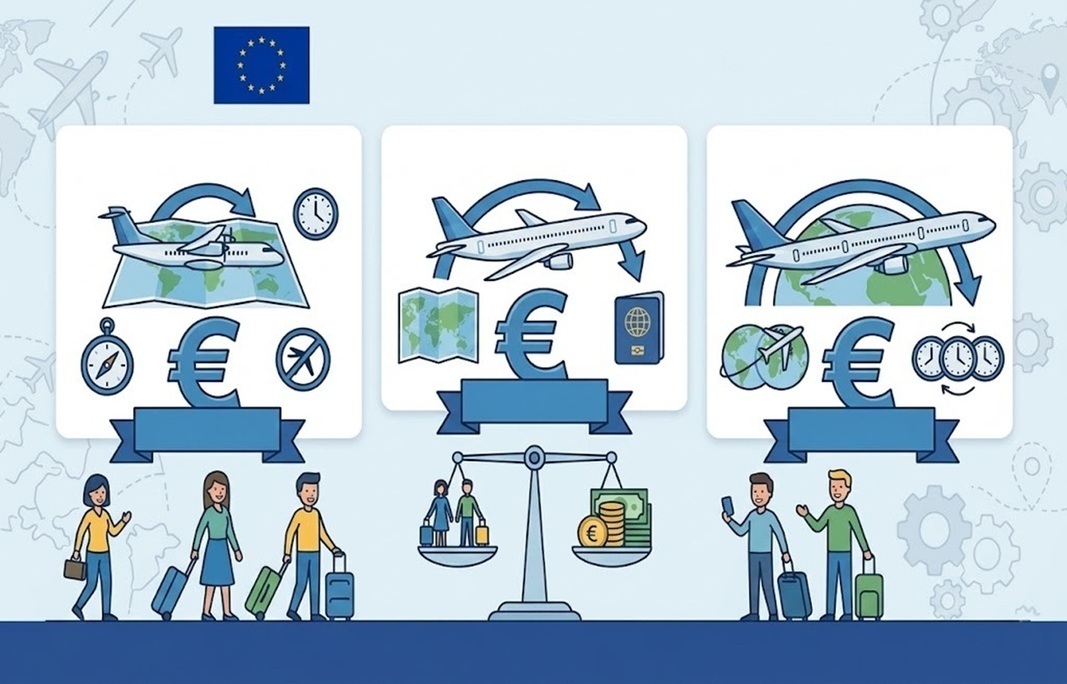
For cancellations or significant delays on short-haul flights.
Compensation may be reduced by 50% if re-routing is offered promptly.
For cancelled or severely delayed long-haul flights.
Right to assistance (during a delay): For waits of 2 to 4 hours or more, the airline is required to provide meals, drinks, and access to communication at no cost. If an overnight stay is necessary, accommodation and transfers must also be covered by the carrier.
Your options if a flight is cancelled: You can request a full refund, immediate re-routing to your destination, or rebooking at a later date. The choice is yours.
Extraordinary circumstances: Airlines are exempt from paying compensation when the disruption stems from events beyond their control — such as extreme weather, strikes, political instability, or unforeseen safety-related technical issues. However, your right to assistance (meals, accommodation) remains in force regardless of the cause.
Important legal notice: By law, passengers must submit claims for compensation for flight delays or cancellations directly to the airline themselves. Although Admiral.Travel provides comprehensive information support, the final decision regarding payment is made by the carrier based on your personal claim.
The free checked baggage allowance varies depending on the airline. Although many passengers expect a standard 20 kg checked baggage allowance, most charter flights currently accept 23 kg (sometimes 20 kg or 25 kg). For long-haul destinations, airlines like Turkish Airlines even allow up to 30 kg. In your carry-on, liquids are limited to 100 ml per container (with an exception for departures from Romania via Bucharest OTP, Băneasa, Cluj-Napoca, and Sibiu airports as of March 2026, where the limit has increased to 2 litres thanks to new CT scanners).
The second biggest source of pre-flight stress? Baggage weight. Aviation rules leave no room for error: aircraft weight balance directly affects fuel consumption, and airlines know it. According to the SITA Baggage IT Insights 2025 report [5], baggage delay rates drop significantly when passengers stick to the weight limits at check-in. Packing right is the best preparation for any beach holiday.
Once that logistical detail is sorted, you're one step closer to a worry-free trip. One important heads-up: if you're flying out of Bucharest with a connection through an airport that doesn't have 3D scanners, larger liquid containers will be confiscated on your way back. And if peak-hour queues make you anxious, the Fast Track security lane eliminates the wait entirely — ask at the airport desk for details.
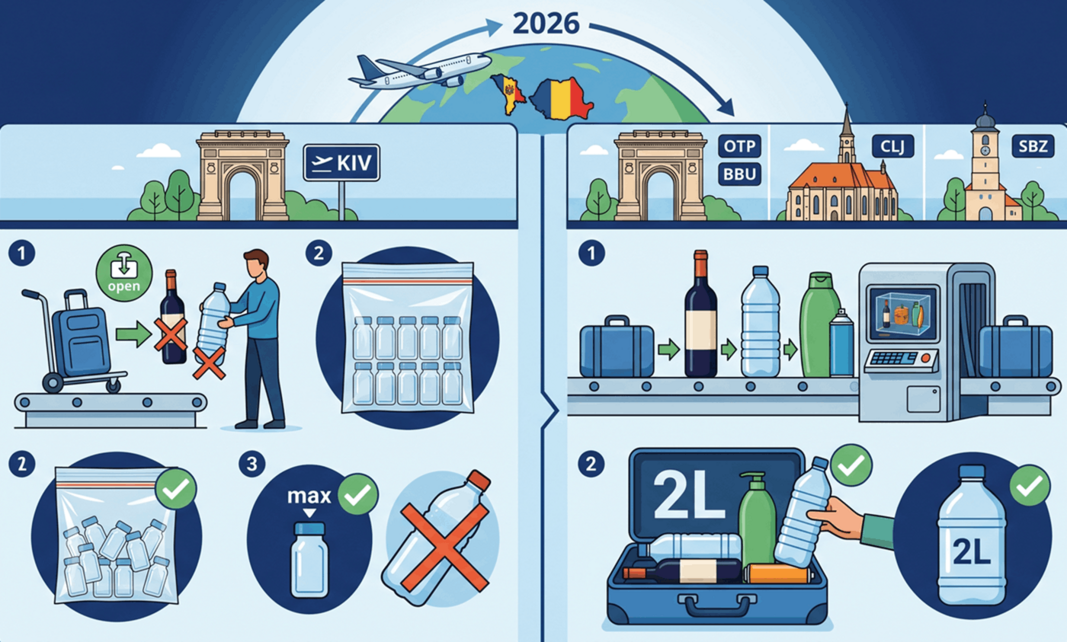
Most charter flights allow 20 kg of checked baggage at no charge. Any excess is subject to additional fees set by the airline, independently of the travel agency.
Your carry-on must fit in the overhead bin. Check out the full carry-on rules for Turkish Airlines for detailed dimensions.
The EU rule still applies: liquids must be in containers of no more than 100 ml each, all fitting inside a single transparent, resealable bag of no more than 1 litre (approximately 20×20 cm). Exceptions apply for medication and baby food, provided you have the relevant documentation.
Great news for passengers! Thanks to new 3D CT scanners installed from 11 March 2026, the 100 ml restriction has been lifted entirely. Individual containers of up to 2 litres are now allowed without a transparent bag. Please note: on your return journey, if your departure airport hasn't yet upgraded to new scanners, the 100 ml rule still applies.
A PIR (Property Irregularity Report) is the official form you fill out at the airport's Lost & Found desk. It must be completed before you leave the arrivals area — without it, you cannot file a compensation claim.
If your checked baggage hasn't arrived, do not leave the arrivals area before filing a complaint. Without a PIR report, airlines are within their rights to reject any compensation requests.
Your boarding pass, ID, and the baggage tag with the barcode.
Provide exact details: brand, size, color, and any distinguishing features. Avoid vague descriptions.
A current address where the airline can deliver your bag once it's found.
If your bag is delayed (up to 21 days), the airline must deliver it free of charge, and you're entitled to purchase essential items and claim reimbursement with receipts. If your bag isn't found within 21 days, it's officially declared lost. Under the Montreal Convention [6], you can claim compensation of up to €1,900 (1,519 SDR), provided you can document the value of the lost items.
Minors travelling with only one parent require a notarized consent form from the other parent (Romanian law). In the Republic of Moldova, one parent is sufficient — no additional declaration is required. Always verify the specific requirements of your destination country.
For families heading on holiday, border regulations are strict — they exist to prevent the unauthorized removal of children across borders. The rules differ significantly between Romania (RO) and the Republic of Moldova (MD). The table below outlines the key scenarios.
| Legal Aspect | Romania (RO) | Republic of Moldova (MD) |
|---|---|---|
| Required Document | Passport or ID card (ages 14+, valid within the EU) | Individual passport required from birth |
| Travelling with One Parent | Notarized consent from the other parent required | One parent is sufficient; no additional declaration needed |
| Travelling with a Third Party | A notarized statement from both parents + a certificate of no criminal record for the accompanying person | Notarized declaration from one parent or legal guardian required |
Note: always check the official border authority websites before you travel, as your destination country may have additional requirements.
Cancellation insurance covers you before departure and reimburses the cost of your package. Medical insurance covers emergency situations that arise at your destination during the trip. These are two separate products — and both are recommended.
A common misconception: if a child falls suddenly ill the night before a charter flight, only cancellation insurance will cover the cost of the cancelled package. Medical insurance doesn't apply in that scenario. If you'd like personalized advice, the team at Admiral.Travel can help ensure you travel with peace of mind, knowing your investment is fully protected.
Applies before departure. Covers unforeseen events such as illness, injury, visa denial, or the death of a family member. Reimburses 80% to 100% of the package cost.
Applies exclusively during your trip. Covers medical emergencies at your destination: hospitalization, consultations, medication, and medical repatriation.
Otopeni Airport (OTP) is accessible by Bus 783 Express (24/7, 40–60 min), CFR train (20 min from Gara de Nord), or taxi/rideshare (50–80 lei, 30–45 min). Chișinău Airport (KIV) is served by trolleybuses 30/165 and taxis/Yandex (~120–150 MDL, 15–20 min).
Getting to the airport deserves just as much planning as the flight itself — especially if you've booked travel packages departing from Chișinău.
Transfers: Bus 783 Express (24/7), CFR train to Gara de Nord (20 min), taxi/rideshare (50–80 lei), private transfer.
Long-stay parking: Official P3/P5 car parks are a reliable option: 100 lei/day for the first 4 days, then 10 lei/day after that (e.g., 7 days = 430 lei). Online booking available.
Transfers: Trolleybus 30/165 (budget-friendly, 30–40 min), official taxi/Yandex (120–150 MDL, 15–20 min), or regular minibuses to the city centre. For the most seamless experience, consider travel packages departing from Chișinău that include a transfer.
Long-stay parking: The official car park costs approximately 200–400 lei/day. Private options are also available (e.g., Top Parking, 31 August 1989 Street) with 24/7 CCTV and a short taxi ride to the terminal.
Beyond the schedule, another element that can shift at the last minute is the cost of fees. You've paid for your package, everything seems settled — and then a notification arrives asking for a top-up. Frustrating, I know. The explanation lies in macroeconomics: airport charges can fluctuate unexpectedly in line with global fuel market movements.
Since 2024, oil price volatility has pushed carriers to include price-adjustment clauses in their contracts. These revised charges are not a sign of bad faith on the agency's part — they directly reflect the realities of the global energy market. Annoying, but that's the reality.
Watch out for hotel tourist taxes: On top of airport fees, many destinations charge local or tourist taxes that are paid directly at the hotel on check-in or check-out. These are not included in your package price and vary from country to country — for example, in Turkey, Greece, or Egypt. They typically range from €1 to €5 per person per night. Ask your Admiral.Travel consultant about the tourist tax for your specific destination before you leave.
Cabin humidity levels drop below 20% — that's 3 to 4 times drier than normal indoor air. Drink water regularly, avoid alcohol and coffee during the flight, and move around every 30 to 60 minutes to prevent leg swelling [6].
Cabin air humidity often drops below 20% — sip water consistently throughout the flight. Avoid caffeine and alcohol: they accelerate dehydration and overstimulate your nervous system. Also skip heavy meals before boarding — reduced cabin pressure amplifies bloating and discomfort.
Dress in layers and opt for natural fabrics (cotton, linen). On longer flights, compression socks can make a real difference in preventing leg swelling. Get up every 30 to 60 minutes and do ankle rotations in your seat. If you're on a night flight or anything over 4 hours, a neck pillow and sleep mask will make the journey noticeably more comfortable.
Turbulence is uncomfortable — but it's not dangerous. It's simply the aircraft responding to air currents, much like bumps on a road. If anxiety kicks in, these techniques work fast:
Look around and identify: 5 things you can see, 4 you can hear, 3 you can touch, 2 you can smell, and 1 you can taste. Your attention snaps back to the present moment immediately.
Inhale for 4 seconds, hold for 4 seconds, exhale for 4 seconds, pause for 4 seconds. Repeat 4 times. This immediately lowers your heart rate and calms your nervous system.
As soon as you board, set your watch to your destination's time zone. After landing, get as much natural light as possible and adjust your meals and sleep schedule to local time straight away.
💡 Bonus tip: Don't rush to stand up the moment the plane lands. Waiting calmly for the aisle to clear reduces stress and is much kinder to your back after hours of sitting.
Good preparation starts with a clear list. Tick off each item before leaving for the airport so nothing slips through the cracks:
| Action Required | Details and Tips | Status |
|---|---|---|
| Confirm Your Flight | Check your charter flight's current schedule 24 hours before departure. | |
| Airport Check-In | Arrive 2 to 3 hours before departure to drop off luggage and collect your boarding pass. | |
| Weigh Your Luggage | Make sure your checked bag doesn't exceed 20 kg. | |
| Check Your Documents | Passport valid for at least 6 months; children's documents, cancellation insurance, and medical insurance. Keep the originals in the hotel safe and carry a paper copy plus a photo of your passport and policy on your phone. | |
| Travel Medical Kit | Pack the essentials from home: pain relievers, anti-diarrhea medication, antihistamines, and plasters. Don't rely solely on pharmacies at your destination. | |
| Sun Protection | If you're heading somewhere warm, bring SPF 50+ sunscreen and a hat or cap. Sunburn hits fast in Mediterranean or tropical climates. | |
| Offline Map | Download an offline map of your destination before you leave (Google Maps, Maps.me). Explore the area around your hotel so you can hit the ground running on arrival. | |
| Roaming / Mobile Data / e-SIM | Turn on roaming, buy a local SIM card, or get a convenient e-SIM before you leave. Losing your connection in an unexpected situation can seriously complicate things. |
0 / 8 completed
Preparation doesn't stop when you step off the plane. A few simple habits at your destination can save your holiday — from keeping your documents safe to navigating the local food scene and finding your way around an unfamiliar place.
If you only have hand luggage and you've already checked in online, you can head straight to passport control, skipping the check-in queue entirely. That's a saving of 30 to 60 minutes during peak hours.
When trying new restaurants, pay attention to allergens and spices. Mediterranean, Asian, and African cuisines may contain nuts, shellfish, or unexpectedly hot dishes. Always ask about ingredients if you have intolerances.
Before you go, pick up at least: hello, thank you, where is...? and help in the language of your destination. A minimal effort that locals genuinely appreciate — and one that could prove invaluable in an unexpected situation.
The gap between the stressed-out tourist at the airport and the traveler who arrives relaxed isn't luck. It's preparation. Confirm your schedule 24 hours in advance, stay within the 20 kg checked baggage limit, keep your documents close, and show up 2 to 3 hours early. That's all it takes for a flight without the drama.
Now that you know everything you need, there's just one thing left: pick your destination. The team at Admiral.Travel will put together the best charter package — flight, transfer, and accommodation — tailored to your budget and dates.
Free, no strings attached. An Admiral.Travel consultant will get back to you within 24 hours.
Yes, airlines are legally entitled to change their schedules. Admiral.Travel will notify you, but make sure to independently verify your flight details 24 hours before departure on the airport's official website.
Charter flight check-in desks open directly at the airport 2 to 3 hours before the scheduled departure time — unlike low-cost carriers, where check-in is handled online.
The free checked baggage allowance is 20 kg on most charter flights. Carry-on liquids are limited to 100 ml per container (or 2 litres for departures from Bucharest from March 2026).
Airport fees fluctuate due to movements in international fuel prices. These adjustments are regulated by the airlines themselves and have nothing to do with the travel agency.
Turbulence is uncomfortable but not dangerous — it's a normal aircraft response to air currents. Try the box breathing technique: inhale for 4 seconds, hold for 4, exhale for 4, pause for 4. Or use the 5-4-3-2-1 grounding technique: identify 5 things you can see, 4 you can hear, 3 you can touch, 2 smells, and 1 taste. Both techniques reduce anxiety almost instantly.
As soon as you board, set your watch to your destination's local time. After landing, get as much natural daylight as possible, avoid naps longer than 20 minutes, and shift your eating and sleeping schedule to match local time immediately. Staying hydrated during the flight and avoiding alcohol will also speed up your adjustment.
Under EU Regulation 261/2004: €250 for flights up to 1,500 km, €400 for routes between 1,500 and 3,500 km, and €600 for longer distances — provided the cancellation was not caused by extraordinary circumstances.
A PIR report must be completed at the airport's Lost & Found desk before you leave the arrivals area. Have your boarding pass, ID, and baggage tag ready. The airline has up to 21 days to locate your bag, and compensation can reach €1,900 under the Montreal Convention.
Four simple steps: (1) confirm your flight 24 hours before on the airport website, (2) weigh your bag at home and make sure it's under 20 kg, (3) get your passport, children's documents, and insurance ready, and (4) arrive at the airport 2 to 3 hours before departure for in-person check-in.
Disclaimer: flight schedule and fee information is subject to change at the airlines' discretion. Contact your Admiral.Travel consultant for the most up-to-date details.